Know What's Proven, What's Hype, and What to Ask Before You Try Peptides
Move Better. Feel Better. Live Better.
A friend swears BPC-157 fixed his elbow. A podcast calls peptides the future of aging. A clinic down the street now sells "peptide therapy." Everyone has an opinion, and almost no one shows you the evidence. This guide does. It's written in plain English by a physical therapist, and every claim is graded on the evidence.

Curious About Peptides but Unsure Who to Believe?
Peptides went from a niche corner of science to dinner-table conversation in just a few years. The trouble is that the loudest voices are often the ones selling something, and the most cautious voices rarely explain why. You're left to sort out the difference between a real tool and an expensive experiment on your own.
"Studies Show…" (In Rats)
Many popular peptides have an impressive stack of research behind them, but most of it was done in animals. One 2025 review of BPC-157 in sports medicine found 35 animal studies and just one in humans.[1]
Headlines That Say "Legal Now"
The 2026 FDA changes were real, but they didn't approve anything. An advisory panel's vote is a recommendation, and the formal rules still haven't been written.[2] Most headlines skipped that part.
Money Spent on the Wrong Problem
Clinic programs can run hundreds of dollars a month. Meanwhile, the habits that reliably build strength, recovery, and confidence often go untouched, because a vial feels easier than a plan.
I didn't want to be the guy who said no to everything. I just wanted someone to tell me straight what we actually know.
The Buzz Is Loud. The Evidence Is Still Catching Up.
The good news: you don't need a science degree to sort this out. You need a clear framework and honest grades.
"Peptides" Means Four Very Different Things
A scoop of collagen in your coffee and an injection bought online share the same word, but the evidence, the oversight, and the risk are completely different. Most confusion comes from mixing them up.
Once you know which kind someone is talking about, every claim gets easier to judge.
Food & supplement peptides Low risk
Collagen peptides and protein hydrolysates. Taken by mouth, with modest but real benefits for some people, mainly alongside exercise.
Skin-care peptides Low risk
Copper peptides and similar ingredients in creams and serums. Regulated as cosmetics, with subtle effects.
Approved peptide medicines Prescription
Insulin, GLP-1s like semaglutide and tirzepatide, and bone-building peptides. Proven in large trials for specific conditions.
Unapproved "research" peptides Unknown risk
BPC-157, TB-500, CJC-1295 and others. Little human data, and quality depends entirely on the source.
Here's What Changes When You Have the Full Picture


Instant download • Read it tonight

Created by a Physical Therapist With 26 Years in the Field
"My job is to help you tell the difference between a real tool and a shiny distraction."
Hi, I'm David. For the past 26 years I've helped thousands of people move better, from professional athletes to a 94-year-old who wanted to stay independent. I'm a Physical Therapist and Certified Strength and Conditioning Specialist, and I founded Movement Answers to help active adults stay mobile, capable, and confident for life.
Lately, almost every client asks me the same question: "What do you think about peptides?" I wrote this guide to give them, and you, an honest answer. This guide isn't a sales pitch for any peptide, and I won't tell you what to inject. I'll show you what the research says, what's still unknown, and how to make a smart decision with your doctor.
Honest. Evidence-informed. No sales pitch.
David Hawkins, PT, CSCS
Founder, Movement Answers
The Questions People Bring Me Every Week
"My golf buddy swears by BPC-157 for his elbow. I've had tennis elbow for a year. I just want to know if it's real or if I'd be wasting my money."
— Mark, 58
"I started a GLP-1 three months ago and I'm down 22 pounds. But carrying groceries feels harder than it used to, and nobody mentioned that part."
— Linda, 61
"A clinic quoted me $400 a month for a 'longevity stack.' When I asked about the research, they handed me a brochure. I wanted a second opinion from someone who'd just show me the evidence."
— Greg, 54
"I play in senior pickleball tournaments. I had no idea some of these are banned in tested events, even out of competition."
— Diane, 66
These are composite examples based on questions David hears from clients and patients. They are not verbatim quotes from named individuals to respect client privacy.
Peptides Decoded: The Active Adult's Evidence-Informed Guide to Peptides
29 pages in five clear sections. Every peptide gets a simple evidence grade, so you always know how much confidence the research supports.
Proven use
FDA-approved after large human trials, for a specific condition.
Promising
Several controlled human trials show a benefit, usually modest.
Early human data
A few small or uncontrolled human studies. Interesting, but unproven.
Mostly lab & animal
We don't yet know if it works, or is safe, in people.
What Peptides Are, and How to Read a Health Claim
Peptides explained in plain language: how these tiny messengers work, why most are injected, and the four kinds of peptides you'll hear about.
- Peptides 101, without the jargon
- The four kinds of peptides, side by side
- Five tips for translating "studies show…"
The Rules, Decoded
What the 2026 FDA changes actually did and didn't do, how peptides reach you, and what a certificate of analysis can and can't tell you.
- A dated, plain-English 2026 timeline
- Approved vs. compounded vs. "research use only"
- Sport, military, and cost realities
Graded Profiles of the Peptides Everyone's Talking About
What each one is, what's claimed, what the research actually shows, the risks, a PT's take, and the question to ask your provider.
- Collagen, GLP-1s, and bone-building peptides
- BPC-157, TB-500, and growth hormone peptides
- GHK-Cu, MOTS-c, epitalon, Semax & more
Tools to Judge Any Product, Clinic, or Claim
An honest look at the real risks, who should be extra cautious, and practical tools you can use before you spend a dollar.
- The Peptide Decision Filter (traffic-light tool)
- Red flags and green flags in a seller or clinic
- A provider conversation worksheet
What Works Better Than Anything in a Vial
Your body makes its own peptide signals every time you train, sleep, and eat well. Here's how to put that to work.
- On a GLP-1? A plan to protect your muscle
- Healing a cranky tendon or joint, step by step
- A 12-week tracker to measure what matters
Instant PDF download • Read on any device or print it
Inside Peptides Decoded
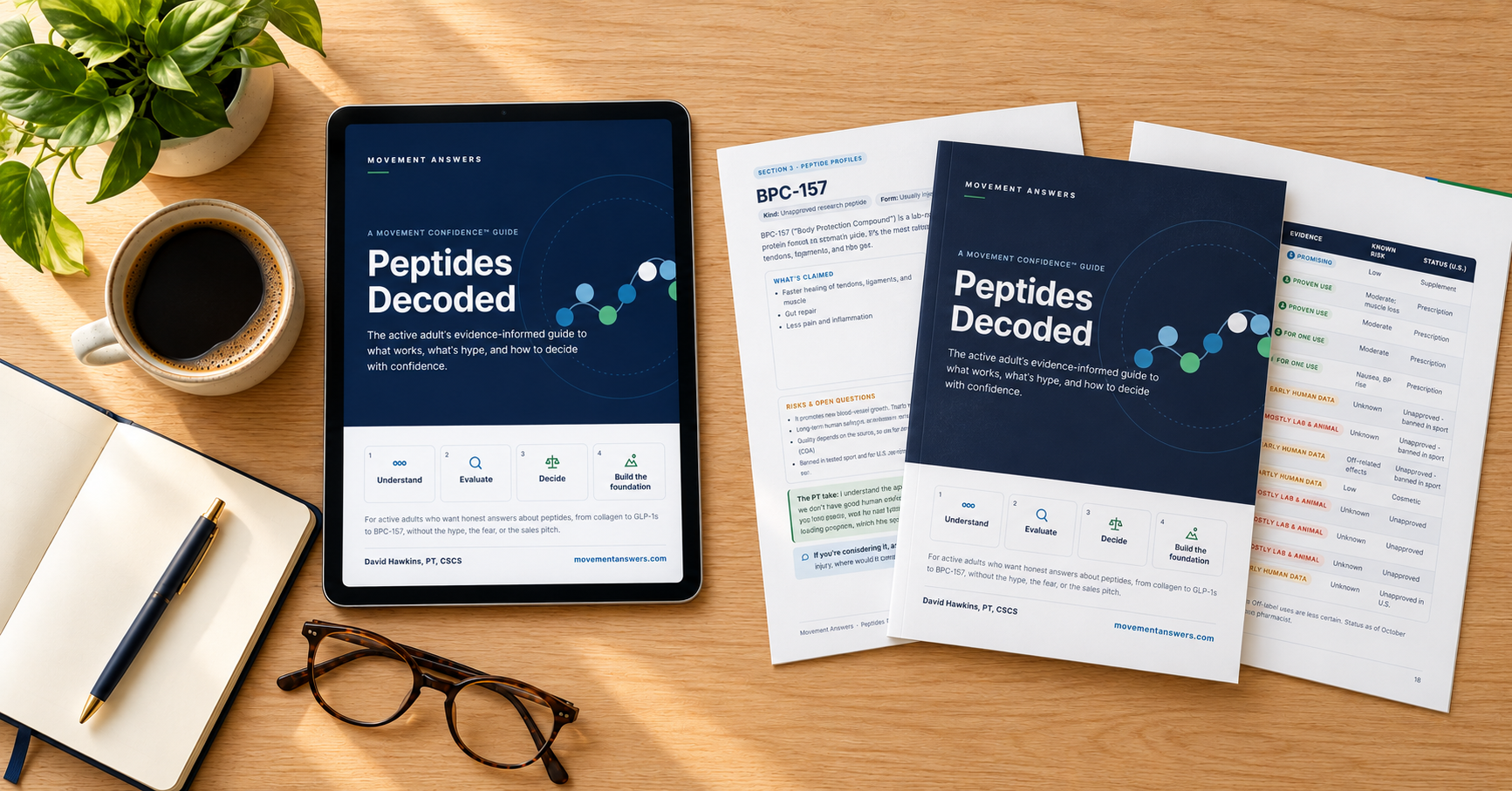
The Complete 29-Page Guide
Five sections covering the science, the 2026 rules, graded peptide profiles, decision tools, and the foundation that works.
At-a-Glance Evidence Table
Every peptide in the guide on one page, with its evidence grade, known risks, and U.S. status.
The Peptide Decision Filter
Five questions and a traffic-light system to judge any product, clinic, or claim.
Provider Conversation Worksheet
Eight questions to print and bring to your next appointment.
GLP-1 Muscle-Protection Plan
Strength, protein, and simple monthly tests to keep your strength while the scale drops.
12-Week Outcome Tracker
Track sit-to-stands, balance, pain, and sleep, so you can see what's actually working.
Glossary & Selected References
Plain-English definitions plus the research behind every claim, so you can dig deeper.
Get Peptides Decoded — Instant Access

One-time payment. Instant PDF download. Yours to keep.
- 29-page evidence-informed guide
- Graded profiles of 15+ popular peptides
- Decision Filter, provider worksheet & 12-week tracker
- GLP-1 muscle-protection plan
Backed by a 30-day money-back guarantee
What Makes This Different
Most peptide guides read like sales brochures. This one is written by a physical therapist, and it promotes no peptide product.
Every peptide gets an honest evidence grade, so you can see at a glance what's proven and what's still a guess.
It's current as of October 2026, including the April FDA changes and the July advisory vote, explained without the spin.
It doesn't stop at "maybe." You get tools to decide: a traffic-light filter, a sourcing checklist, and a worksheet for your doctor.
It shows you what outperforms any peptide: strength, protein, sleep, and movement, with plans you can start this week.


Is This the Right Guide for You?
Right for you if you…
- Keep hearing about peptides and want honest, evidence-based answers
- Are considering a peptide, a clinic, or a GLP-1 and want to ask better questions
- Already use peptides and want to understand the evidence and the risks
- Want to protect your strength and stay active for years to come
- Prefer plain English over jargon and hype
Not for you if you…
- Want dosing, mixing, or injection instructions. This guide doesn't give them; that belongs with a licensed prescriber
- Are looking for a list of where to buy peptides
- Want someone to promise a miracle result
- Need individual medical advice. Please see your physician
Instant access • One-time purchase • Keep it for life
Try It Risk-Free
100% Money-Back Guarantee

Peptides Decoded comes with a 30-Day Satisfaction Guarantee. If you don't find it clear, honest, and useful, contact us within 30 days for a full refund. No questions asked.
Frequently Asked Questions
Is this for or against peptides?
Neither. It's for you making an informed decision. Some peptides are proven, approved medicines. Some have modest support. Many are still mostly lab and animal research. The guide grades each one honestly and shows you how to weigh the evidence yourself.
Does the guide include doses or injection instructions?
No. Most popular peptides aren't approved for human use, so there's no reliable, tested dose to give, and dosing belongs with a licensed prescriber who knows your health history. The guide helps you understand the evidence and ask your provider the right questions.
I already use peptides. Is this still useful?
Yes. You'll learn what the research does and doesn't show for what you're using, how to check your source and certificate of analysis, which side effects to watch for, and how to track whether it's actually helping.
Is David a doctor? Can he prescribe peptides?
David is a licensed Physical Therapist and Certified Strength and Conditioning Specialist, not a physician, and he doesn't prescribe peptides. This guide is educational. Always talk with your physician or a licensed prescriber about any medication or supplement.
How do I get the guide?
Right after checkout you'll get instant access to a 29-page PDF. Read it on your phone, tablet, or computer, or print it out. The worksheet and tracker pages are designed to print.
The rules keep changing. Is the guide current?
It's current as of October 2026, including the April 2026 FDA changes and the July 2026 advisory committee vote. Because the rules are still moving, the guide also shows you how to check a peptide's current status with your prescriber or pharmacist.
Ready for Straight Answers About Peptides?
Move Better. Feel Better. Live Better. Make your next decision an informed one.




Written by a Physical Therapist • 30-day guarantee